A beginning. A path. A point.
Connected chapters explain the project’s purpose, a practical workflow, and how its parts fit together.

 Code, worth listening to
Turn the GitHub repositories you’re curious about into stories you can take with you.
In private preview · For iPhone & Mac
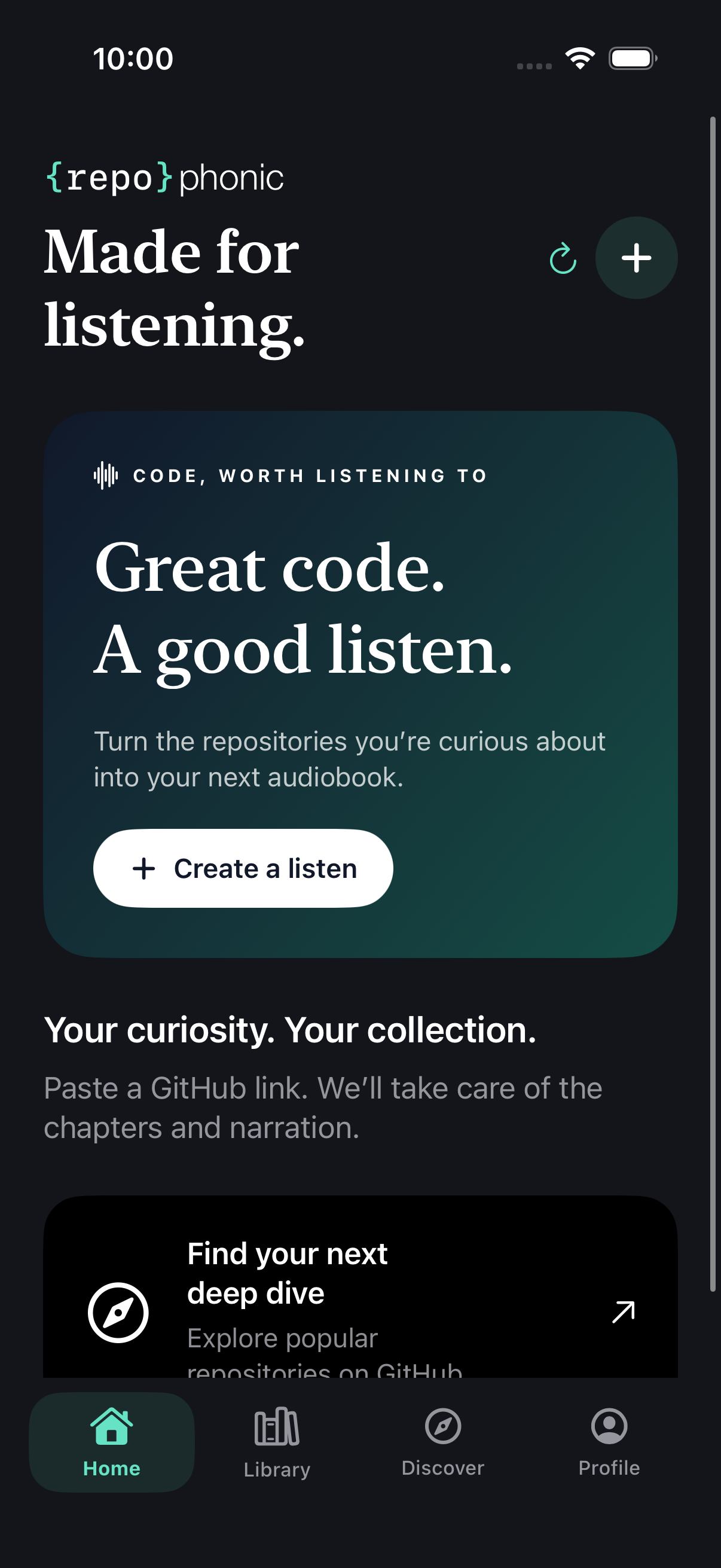 From source code
The app, in private preview.
A little less scrolling. A little more listening.

From first reply to responsible access.
Listen to chapter one
Get to know OpenClaw: an assistant you run, the conversations it connects to, and the Gateway at its center.
An actual Repophonic recording. Script and voice are AI-generated. This is an independent introduction, not an OpenClaw production.
Welcome to Repo Phonic. Today, we're going to dive into the openclaw repo. We'll cover four chapters to understand how your first chat reaches an assistant you run and which access decisions remain yours.
Chapter one. Your Assistant, One Gateway.
OpenClaw is an open-source AI assistant that runs on your own computer and reaches you through familiar chat services, including WhatsApp, Telegram, Slack, and Discord, as well as native apps. You can run it as a personal assistant on a laptop or configure it for a shared team. For someone who wants an assistant in the conversations they already have, that is its practical promise: you operate the system without making a new chat interface your only way in.
Running it yourself does not mean every part of a conversation stays on your computer. State, memory, and credentials live on your hardware, but prompts go to the model provider and chat platforms you configure, plus any diagnostics export you enable. Models and agent harnesses are replaceable plugins. Local ownership of the assistant’s state and your choice of services are separate decisions; neither should be mistaken for a promise of entirely local processing.
At the center is the Gateway, the local control plane that manages sessions, tools, events, and channel connections. The Control UI, command-line interface, and terminal interface connect to it. Messaging channels bring the assistant into existing services. Companion apps and device nodes add voice, Canvas, camera, screen, and device-local actions on supported platforms. These are different ways to interact with a system organized around the same Gateway.
Hosted or local model providers supply model access, while tools, skills, and plugins extend what the assistant can do. You do not need to begin by connecting every surface or adding every capability. The documented first check is simpler: complete onboarding, open the Control UI, and send a message. That small journey makes the relationship between the interface, the Gateway, and the model easier to understand.
From a saved revision of openclaw/openclaw (8b20c41). This sample reflects that revision, not subsequent changes.
From a link to a listen
Pick a public repository you want to understand. Start with the project that’s been sitting in your tabs.
Repophonic builds a chaptered introduction from the README, documentation and relevant code, with source references you can follow.
What it is. How it works. Where to start.
Take it on a walk. Download it for the commute. Move between chapters, revisit a passage and keep your place.
Your next deep dive can leave the desk.
A good story is worth sharing. If a matching edition is already in the catalog, you can listen without using a new creation. Each new recording grows the collection for everyone.
Made for the way you listen
There’s more to understanding a repository than hearing its README read aloud.
Connected chapters explain the project’s purpose, a practical workflow, and how its parts fit together.
Open the transcript and follow references back to the repository version behind your edition. AI can make mistakes; the source is always your next step.
Follow a repository and create a short “What changed?” listen when there’s a new revision. A fresh recording uses a creation from your allowance.
One membership. Plenty to explore.
We handle the research, writing and narration. You just bring the repo.
No separate AI account or API key needed.
$12.99USD / month
Newly generated books, updates and unavailable narrator versions share the same three-creation allowance. Reusing a matching recording uses none.
See launch availabilityPricing is a launch draft. Purchases are not open. The current invitation preview is separate from the planned membership.
A few things to know
No. The README grounds the introduction, with relevant documentation and code informing a connected story. Chapters cover what the project does, a practical workflow, and its main components.
A new recording counts as one creation. That includes a new book, a newly generated update or catch-up, or an unavailable narrator version. If the matching repository version, story length and voice are already available, you reuse that recording without spending a creation. The proposed monthly plan includes three creations, not unlimited generation.
Listen to the sample chapter for free, with no account or payment details. Free sample listening does not include new audiobook creation or full-catalog access. The launch membership includes three new creations per billing month and unlimited existing-catalog listening. Private invitations have a separate, limited preview allowance.
No. Repophonic handles writing and narration through its hosted service. Public repository material is processed by cloud AI providers; this is not an entirely on-device service.
Yes. Once a book’s audio has downloaded in the app, you can listen offline. Creating a new edition, checking for updates and downloading audio require an internet connection. You can remove a download to free space while keeping the book in your library.
Stories are grounded in a saved repository revision and checked for factual support and coverage before narration. The transcript includes source references. These checks reduce mistakes; they do not guarantee every statement is correct. Use the original documentation for implementation and important decisions.
Repophonic is in private preview for iPhone and Mac. Public TestFlight and App Store links will appear here when they are available. There is no public download or checkout yet.
Your next listen is taking shape
Coming to iPhone and Mac. Currently in private preview.